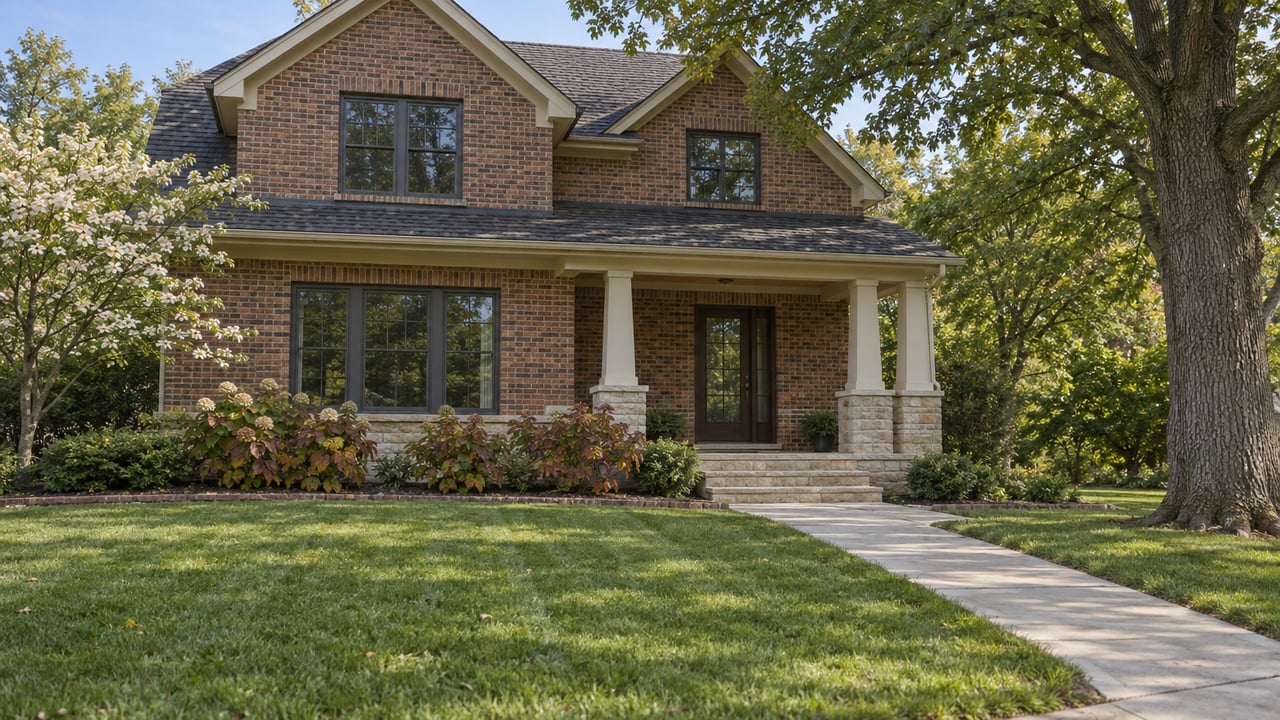
Every driver who takes Signal Mountain Boulevard up from Chattanooga knows the space house. It sits at the upper hairpin turn, the kind of landmark you use for directions rather than an address, and this year it also marks one end of a work zone. According to the Chattanooga Times Free Press, TDOT ran five days of preliminary boring and utility work there in March, then said full construction on the slope stabilization project would begin by early summer, which means the flaggers most residents are seeing by late summer are not a one-off inconvenience but the start of the real project. What most residents have not connected is that Tennessee's Department of Transportation has already run this exact repair on this exact stretch of road, twice, and both times it went faster than announced.
That track record matters more than the usual construction warning, because this corridor is not just another commute. Signal Mountain Boulevard, also called Signal Mountain Road at the bottom and known on state maps as U.S. 127 and State Route 8, is the only road connecting the town to Chattanooga that can carry ambulances, fire trucks, moving vans, and everyday traffic all at once. Roughly 12,000 vehicles cross this stretch each day, according to 2024 state traffic counts. There is no second route off the mountain for anything larger than a passenger car in a hurry. When this road slows down, the whole town feels it, and when a section of it becomes unstable, there is no detour to fall back on.
Nine Years From Planning To First Cone
The project residents are living through this year did not start in March. According to The Chattanoogan, TDOT began planning miscellaneous improvements to State Route 8 in 2017, with engineering work handled by Arcadis. Surveys followed in 2018. Preliminary plans were finished in 2020. Right-of-way plans came together in 2022, the same year TDOT held a public meeting in the lunchroom at Signal Mountain Middle/High School to walk residents through what was coming. Officials told that room construction would begin in 2026. Four years later, it has.
If you have heard "this is finally happening" about this road more than once over the past decade, that is because it genuinely has taken this long. The project covers 3.05 miles, running from just before Suck Creek Road at the bottom of the mountain to just below Palisades Road at the top. TDOT's plan calls for eight new retaining walls, reshaped drainage ditches, slope scaling and mesh draping in rockslide-prone sections, and new guardrails at some of the tighter curves. The footprint of the road itself will not change. This is a stability and drainage fix, not a widening project, and it is being funded through the state's 10-Year Project Plan rather than a local bond or a special assessment.
Preliminary geotechnical work began March 9, 2026, when contract crews spent five days boring, scanning utilities, and assessing the site between Palisades Road and the top of the mountain. TDOT described the work zone hours during that phase as 9 a.m. to 3 p.m., with all lanes back open by 4 p.m. daily, specifically timed to avoid the school and commute rush. Officials said at the time that full construction, once it starts, would bring similar traffic patterns, one lane controlled by temporary signals uphill and downhill from the space house.
Why This Stretch Keeps Coming Back
This is not the first time the state has poured concrete into this hillside. TDOT completed slope stabilization work near log mile 15.97 in October 2018 and again near log mile 16.05 in November 2018, both close to the same upper hairpin the current project targets. A separate repair followed in 2019 after part of the roadway washed away, adding a section of retaining wall.
The method TDOT uses here is called soil nailing. Crews drill long steel bars, some up to 40 feet, directly into the hillside at close spacing, then grout them in place to reinforce the slope before building a concrete retaining wall in front. Local 3 News reported that a TDOT spokesperson explained the basic idea during the 2018 work: the method stabilizes the slope, and some nails run four stories deep into the ground. It is not a cosmetic patch. It is meant to hold.
What makes this history useful to a driver stuck behind a flagger today is what happened to the timeline last time TDOT ran this exact play near the space house.
| Phase | TDOT's stated estimate | Actual completion |
|---|---|---|
| 2019 slope repair, Signal Mountain Blvd | 8 to 10 weeks | 6 weeks |
TDOT announced the 2019 repair would take eight to ten weeks. Crews finished in six. That is not a small gap. It means the last time this same agency ran the same soil nailing process on the same road, the state undershot its own timeline by a third. There is no guarantee 2026 plays out the same way, weather and scope both matter, but it is the closest available precedent, and it points toward relief arriving sooner than the posted estimate rather than later.
None of this means the work zone will be pleasant. During the 2018 to 2019 phase, the town fielded real complaints from drivers frustrated by long waits at the temporary signals, and TDOT had to remind people not to text or talk on the phone while stopped in a work zone, a reminder rooted in the deaths of three TDOT workers struck by passing motorists in 2016. The frustration was real. It just ended sooner than the department said it would.
The One Weekend TDOT Already Promised To Protect
TDOT had explicitly carved one weekend out of the project schedule: the World's Longest Yard Sale in August, the annual event that runs along U.S. 127 for hundreds of miles and draws shoppers and sellers to towns along the route, including a local version at the Mountain Arts Community Center. Officials had confirmed there would be no closures during the event, and TDOT had built its work schedule around that weekend rather than the other way around, suggesting the department understood this road's role in the town's calendar as well as its commute.
That kind of scheduling awareness is worth noticing because it is the opposite of how the last major disruption on this mountain played out. In 2024, a rockslide forced a full closure of W Road for three weeks, and there was no such accommodation. Residents were told to reroute through Roberts Mill Road, Signal Mountain Boulevard, or Taft Highway, full stop. The current project on Signal Mountain Boulevard is being managed as a phased, single-lane operation with defined daily hours, not an open-ended closure, and that distinction is the difference between a slow commute and losing your route off the mountain entirely.
What This Actually Changes If You Drive This Corridor
For residents living above the space house or making the daily run down to Chattanooga, a few practical points from the record so far are worth keeping in mind.
- Work zone hours during the March preliminary phase ran 9 a.m. to 3 p.m., with lanes fully reopened by 4 p.m., a pattern TDOT says will carry into the full construction phase once it begins.
- The controlled section sits specifically at the hairpin turns near the space house, uphill and downhill, rather than along the entire 3.05-mile project length at once.
- Drivers had been told to expect no closures during the World's Longest Yard Sale weekend in August.
- Past phases of this same repair method on this same stretch finished ahead of the department's own estimate, not behind it.
This road has been called out in past studies as one of the state's higher-risk routes, largely because of the terrain it climbs and the volume it carries with essentially no alternative. The nine-year path from a 2017 planning kickoff to a 2026 construction start reflects how much engineering, right-of-way work, and public process goes into fixing a road that cannot be closed for long without cutting the town off. It is a slow way to get a safer commute, but the record on this exact stretch says the slow part is mostly the planning, not the digging.
If you are watching flaggers at the space house this year, the history says the wait is more likely to be shorter than TDOT's next estimate than longer. That is not a small thing for the road you take home every day.
Signal Mountain has always been the kind of place where people pay close attention to the details of daily life here, from the one road up the mountain to the events that fill its calendar. If you are curious about what is happening in this community beyond the headlines, The Robinson Team keeps a close eye on the neighborhoods we call home. Reach out anytime to talk about what is happening on the mountain.